Wellness
Fasting for Beginners: A Step-by-Step Guide
Medically reviewed by:Medura Clinical Team
Last updated:July 29, 2026
Starting a fasting routine can feel intimidating if you've only heard about the more extreme versions, alternate-day fasting, multi-day water fasts, or skipping entire days of eating. In reality, most people who successfully adopt fasting as a long-term habit started with something much gentler and built up gradually. This guide walks through exactly how to begin, a realistic week-by-week progression, and the most common mistakes and myths that trip up new fasters.
Start With Where You Already Are
Before building a formal fasting schedule, it helps to know that most people are already fasting for a portion of every day without thinking about it, the hours between dinner and breakfast. If you finish eating at 8 PM and don't eat again until 7 AM, you've already completed an 11-hour fast overnight. Recognizing this starting point makes the idea of fasting feel far less foreign than jumping straight into an unfamiliar 16-hour window.
According to the National Institute on Aging, intermittent fasting is an eating pattern involving hours or days of no or minimal food consumption without depriving the body of essential nutrients, which is a helpful reminder that this isn't about starvation, it's about extending a pattern your body already experiences daily.
A 4-Week Beginner Progression
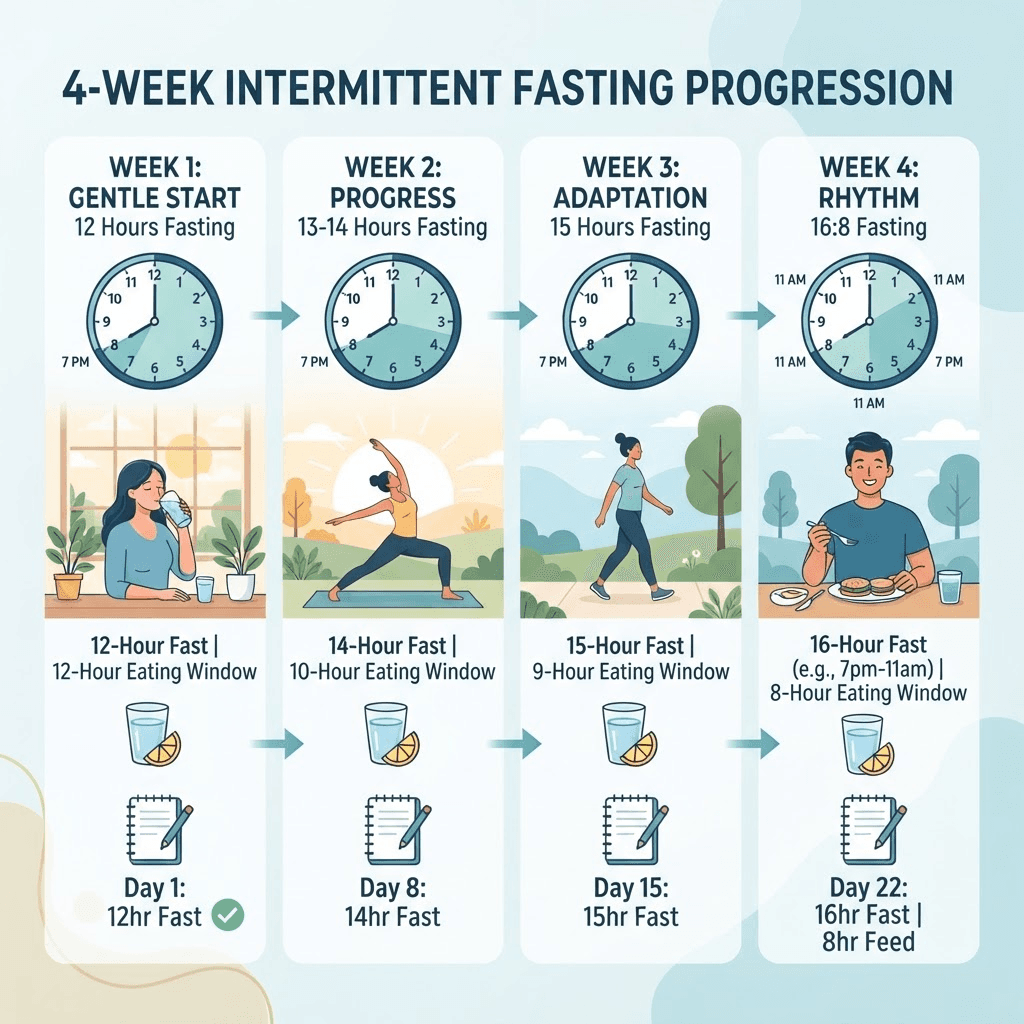
Rather than jumping directly into a 16:8 schedule, a gradual approach tends to be far more sustainable.
- Week 1: 12-hour fast. Stop eating by a consistent time in the evening and don't eat again until 12 hours later. For most people this requires only minor adjustment, cutting out late-night snacking is usually the biggest change. Focus this week on noticing how you feel and adjusting your evening routine to support an earlier stopping point.
- Week 2: 13 to 14-hour fast. Push your first meal back by an hour or two, or move your last meal earlier. Hunger in the mid-to-late morning is common and expected during this stage, staying hydrated and keeping busy tends to help it pass.
- Week 3: 15-hour fast. By this point, many people notice hunger becoming less intense than in week one, an early sign of the body adjusting its hunger signaling to the new eating rhythm.
- Week 4: 16-hour fast (the standard 16:8 pattern). This is the most commonly referenced intermittent fasting schedule, an 8-hour eating window with a 16-hour fast, often achieved by skipping breakfast and eating between roughly noon and 8 PM.
There's no requirement to progress past week 4, or even to reach it. A 12 or 14-hour fasting window is a legitimate, sustainable practice on its own, and research reviewed by the NIH has shown meaningful benefits, including improved blood sugar control and blood pressure effects, even with earlier time-restricted eating windows that fall short of a full 16 hours.
What to Expect Each Week
- Hunger that comes in waves, not a constant state. Hunger during fasting tends to peak and then subside, rather than building continuously. Recognizing this pattern helps distinguish normal fasting hunger from a genuine need to eat.
- Some initial fatigue or irritability. As your body adjusts to a new fuel-switching pattern, mild fatigue or irritability in the first one to two weeks is common and generally temporary.
- Headaches, often related to hydration or caffeine withdrawal. If you're used to drinking coffee with breakfast and now delay your first meal, timing your usual caffeine intake appropriately (black coffee doesn't break a fast) can help prevent headaches tied to a shifted caffeine schedule.
- Improved energy and reduced hunger over time. Most people who stick with a consistent schedule report that hunger becomes noticeably less intense after the first couple of weeks, as the body adapts to the new pattern.
What You Can Have During a Fast
One of the most common beginner questions is what, if anything, is allowed during the fasting window without breaking the fast. Generally considered acceptable: water, plain or sparkling; black coffee, without cream, sugar, or milk; plain tea, without added sugar or milk; and electrolyte supplements without added sugar or calories, useful for longer fasting windows or hot weather. Anything containing meaningful calories, even a small amount of cream in coffee or a splash of juice, technically breaks a fast in the strictest sense, though the practical health impact of very small amounts is a matter of some debate. For beginners, keeping the fasting window strictly calorie-free removes any ambiguity and makes the practice easier to stick with consistently.
Common Beginner Myths, Debunked
Myth: "Fasting puts your body into starvation mode." This is a common misconception. The body's metabolic adaptations to short-term fasting, of the kind used in intermittent fasting, are meaningfully different from prolonged caloric deprivation over weeks. Research published in the New England Journal of Medicine describes fasting's effects in terms of a beneficial metabolic switching process, not a starvation response.
Myth: "You'll lose muscle if you fast." Time-restricted eating on its own, especially when adequate protein is consumed during the eating window, doesn't automatically cause muscle loss. Muscle preservation during any calorie-reduced eating pattern, fasting included, depends heavily on protein intake and resistance training, not on the fasting schedule itself.
Myth: "Fasting is only about weight loss." Weight loss is often a side effect of intermittent fasting, but it isn't considered the primary driver of many of the benefits observed in research. Several studies point to metabolic and cellular effects that occur somewhat independently of weight change.
Myth: "You have to fast every single day to see benefits." Many studied fasting patterns, including 5:2 fasting, only involve restriction on select days of the week, and research on these patterns has still shown measurable benefits, suggesting daily fasting isn't a strict requirement for every approach.
Myth: "Breaking your fast with a large meal is fine as long as you fasted long enough." Overeating significantly during the eating window can offset the calorie balance that supports weight-related goals, and very large meals after an extended fast can occasionally cause digestive discomfort. Breaking a fast with a moderate, balanced meal tends to feel better and support goals more effectively than a large first meal.
Common Mistakes Beginners Make
- Starting with too aggressive a schedule. Jumping straight to 16:8 or beyond in the first week, rather than easing in, is one of the most common reasons people abandon fasting within days.
- Not adjusting caffeine timing. Continuing a normal coffee routine while shifting meal timing can cause avoidable headaches and jitteriness if caffeine is being consumed on a completely empty stomach for longer than usual.
- Treating the eating window as unlimited. An 8-hour eating window doesn't mean unlimited eating within it. Nutrient-dense, adequately portioned meals during the eating window matter for reaching most health and weight goals.
- Giving up after one difficult day. A single hard day, extra hunger, low energy, irritability, is common in the first week or two and doesn't predict how fasting will feel once your body adjusts.
- Ignoring genuine warning signs. Persistent dizziness, significant weakness, or an inability to function normally are different from typical early hunger and are signals to stop and consult a healthcare provider, not signs to push through.
Choosing Which Meal to Skip
New fasters often default to skipping breakfast simply because it's the meal most associated with a shortened eating window, but the right meal to skip depends on your actual lifestyle, not a default assumption. If mornings are hectic and you rarely feel hungry early on, skipping breakfast and starting your eating window around midday tends to require the least adjustment, since you're simply formalizing a pattern that's often already close to your natural habits.
If your schedule involves important social or family meals in the evening, shifting your eating window earlier in the day, an earlier breakfast and lunch with an earlier dinner cutoff, preserves the meals that matter most for your lifestyle while still creating the same fasting duration. If you train early in the morning, some people prefer to have a small amount of protein before or after a workout even within a fasted state, while others prefer to complete their workout fully fasted and eat once their window opens. Both approaches are used successfully; personal preference and how your body responds to fasted exercise should guide the choice.
There's no single correct configuration. The version of a fasting schedule that fits your actual daily rhythm, rather than the version that looks cleanest on paper, is the one most likely to become a lasting habit rather than something abandoned within a few weeks.
Building Consistency Without Rigid Rules
The most successful long-term fasters tend to treat their schedule as a flexible framework rather than an unbreakable rule. Adjusting your eating window on a day with an early dinner plan, a family event, or unusual circumstances, then returning to your normal pattern the next day, tends to support long-term sustainability better than an all-or-nothing mentality that leads to abandoning the practice after one missed day.
Tracking Your Progress Without Becoming Obsessive
Keeping a simple log during your first month of fasting can help you notice patterns that are easy to miss otherwise: what time hunger tends to peak, which days feel easier, and how energy levels shift as you extend your fasting window. A basic note of your fasting hours, how you felt, and anything unusual is enough, this doesn't need to become an elaborate tracking system to be useful.
That said, it's worth avoiding the trap of obsessive monitoring. Weighing yourself multiple times a day, or treating every fluctuation in hunger or energy as data requiring analysis, tends to create unnecessary stress around a practice that's meant to simplify your relationship with eating, not complicate it further. A weekly check-in with your own notes, rather than constant in-the-moment tracking, usually strikes the right balance between useful awareness and practical sustainability.
If you're using this alongside a coach or provider, sharing this simple log during check-ins gives them concrete, specific information to work with, far more useful than a general "it's going fine" or "it's been hard," when troubleshooting what's working and what needs adjustment.
When to Get Medical Guidance Before Starting
Certain groups should talk to a healthcare provider before starting any fasting schedule: people who are pregnant or breastfeeding, anyone with diabetes managed with insulin or other blood sugar medications, anyone with a history of disordered eating, and anyone managing a chronic condition where meal timing interacts with medication schedules. For these groups, fasting isn't automatically off-limits, but it requires individualized guidance rather than a generic beginner's plan.
Fasting Alongside a Broader Weight Goal
For many people, fasting works best as one piece of a larger plan rather than a stand-alone strategy. If you're also working toward a specific weight loss goal, pairing a fasting schedule with support around nutrition, activity, and accountability tends to produce better and more sustainable results than fasting in isolation.
If you're interested in personalized guidance building a fasting and nutrition plan around your specific goals, Medura Coaching offers 1-on-1 support, and the 90-Day Transformation Plan specifically includes a personalized nutrition and fasting strategy built for your individual circumstances. If you're also considering whether a medically supervised treatment like semaglutide or tirzepatide might complement your approach, a licensed provider can help you understand how fasting and GLP-1 treatment interact for your specific situation.
Staying Motivated Past the First Month
The initial novelty of a new schedule tends to fade somewhere around the one-month mark, which is exactly when consistency matters most and also when it becomes easiest to let the habit slip. A few things help carry a fasting routine past this point: Anchor fasting to a genuine reason, not just a trend. People who started fasting purely because it was popular tend to abandon it faster than those who connect it to a specific, personally meaningful reason, more stable energy, better blood sugar numbers, or simply feeling less controlled by constant snacking throughout the day.
Revisit your schedule as life changes. A fasting window that worked well during one season of life, a stable work schedule, a particular routine, may need adjustment when circumstances shift, a new job, travel, a change in family responsibilities. Treating the schedule as adaptable rather than fixed helps it survive these transitions instead of being abandoned entirely the first time it becomes inconvenient.
Notice the cumulative effects, not just daily wins. Some of fasting's benefits build gradually over weeks and months rather than showing up as an immediate daily reward, which is part of why sticking with a consistent pattern for at least a full month before evaluating whether it's working tends to give a more accurate picture than judging it after a few days.
FAQ: Fasting for Beginners
How long should a beginner fast for their first week?
A 12-hour overnight fast is a reasonable, gentle starting point for most people, extending gradually from there.
Is it normal to feel hungry or tired when starting to fast?
Yes. Mild hunger, fatigue, or irritability in the first one to two weeks is common as your body adjusts, and these effects generally improve with consistency.
Can I drink coffee while fasting?
Black coffee, without cream, sugar, or milk, is generally considered acceptable during a fasting window and doesn't interrupt the fast.
Do I need to fast every day to see benefits?
No. Some studied fasting patterns only involve restriction on select days of the week, and research has shown benefits from several different fasting structures, not just daily approaches.
What should I do if I feel unwell while fasting?
Mild hunger or tiredness is normal, but persistent dizziness, significant weakness, or an inability to function should prompt you to break your fast and consult a healthcare provider rather than continuing.
Is fasting safe for everyone?
No. People who are pregnant or breastfeeding, managing diabetes with certain medications, or with a history of disordered eating should talk to a healthcare provider before starting any fasting routine.
The goal is not to fight your body. It is to work with it, one steady day at a time.
This article is provided for general educational purposes and does not replace individualized medical advice. Anyone with a chronic health condition, who is pregnant or breastfeeding, or who has a history of disordered eating should consult a licensed healthcare provider before starting a fasting routine. If you'd like personalized support building a fasting and nutrition plan, Medura Coaching is available to help.