Wellness
Sustainable Exercise: Finding Movement You'll Actually Keep
Medically reviewed by:Medura Clinical Team
Last updated:July 21, 2026
The fitness industry loves intensity. But the movement that changes your life is the movement you can sustain, the kind that fits your life instead of fighting it. You do not need to become an athlete to get tremendous health benefits from movement. You need to find activities you genuinely enjoy, that fit your schedule and your body, and that you can see yourself doing not just for eight weeks but for eight years.
Choose enjoyment over punishment
If you dread it, you will quit it. This is not a character flaw. This is how human motivation works. The fitness approach that involves suffering now for benefits later works for approximately zero percent of people long-term. The movement that changes your life is the movement you look forward to. Walking, dancing, swimming, cycling, hiking, playing a sport, rock climbing, whatever leaves you feeling good is worth infinitely more than a perfect program you abandon in three weeks.
Before choosing your exercise, ask yourself: Do I enjoy this? Does this fit my schedule in a way that does not require constant willpower? Can I see myself doing this in one year? If the answer to any is no, choose something else. This is not settling. This is the foundation of sustainability.
Different types of movement and their benefits
According to the American Heart Association, cardiovascular exercise (walking, running, cycling, swimming) improves heart health, builds aerobic capacity, and supports weight management. It is the most time-efficient for cardiovascular benefits. Strength training builds muscle, increases bone density, supports metabolism, and improves functional strength for daily life. You do not need to lift heavy weights. Bodyweight exercises, resistance bands, or light weights work. Flexibility and mobility work (yoga, stretching, pilates) maintains and improves range of motion, reduces injury risk, and often has calming effects on your nervous system. Most people benefit from a mix of these, but the exact ratio matters less than consistency.
The psychology of sticking with exercise
Research in behavioral psychology shows that exercise adherence depends far more on enjoyment and habit than on knowing the health benefits. You probably already know that exercise is good for you. That knowledge has not made you an athlete. What changes behavior is enjoyment, identity, and habit. When exercise becomes part of your identity, you do it because that is who you are, not because you have to. A person who identifies as someone who walks does not need to motivate themselves to walk. They just walk.
To develop this identity, start small and build from there. Do not try to become a gym person overnight. Try a few walks and see if that identity resonates. Or try a dance class. Try rock climbing. The specific activity matters far less than finding one that makes you feel good enough that you want to do it again.
Starting from sedentary or with chronic conditions
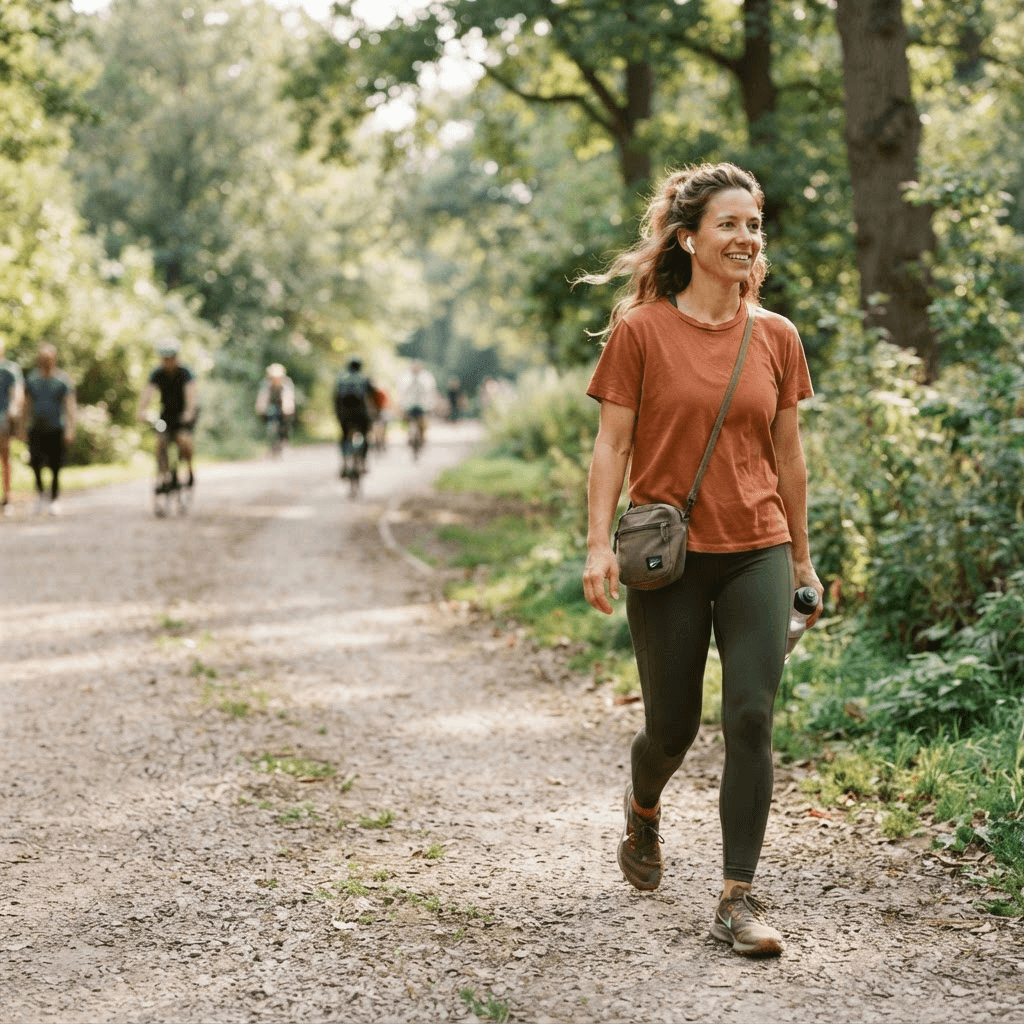
If you have been sedentary, start with walking. Walking is underrated as exercise. A daily 30-minute walk provides significant cardiovascular and mental health benefits. Start with whatever distance feels easy. Five minutes is fine. Build from there. If you have a chronic condition like arthritis, bad knees, or back pain, talk with your provider about what movements are safe. Often, swimming or water aerobics is excellent because the water provides resistance and support. Cycling is often easier on joints than running. Yoga can improve mobility and reduce pain when adapted for your condition.
Building strength gradually without pain
Strength training does not require heavy weights or intense effort to be effective. Bodyweight exercises like push-ups, squats, and planks work if done with good form. Resistance bands provide progressive resistance without the intimidation factor of a weight room. Starting light and building gradually reduces injury risk and improves adherence because you feel stronger without being sore for days afterward. Progressive overload means gradually increasing resistance, reps, or sets over time. This gives your body consistent challenge without overwhelming it.
The sweet spot for strength training is twice per week, targeting major muscle groups. This could be as simple as 20 minutes of exercise twice a week. You do not need to spend hours lifting. Consistency beats volume.
Finding community and accountability
Humans are social creatures. Exercise done with others or within a community has dramatically higher adherence rates than solo exercise. This might be a walking group, a fitness class, a running club, a recreational sports league, or even a virtual fitness community. The specific format matters less than the connection. When you have committed to meeting someone else, you are far more likely to show up even on days you do not feel like it. And often, once you show up, you enjoy it more than you expected.
Common obstacles and how to navigate them
Obstacle one: "I do not have time." You have time for things that matter to you. Movement matters to your health. Even 20 minutes a few times a week makes a difference. Integrate movement into existing activities: park farther away, take the stairs, take walking meetings, or walk during your lunch break. Obstacle two: "I am too out of shape to exercise." Wherever you are is the starting point. Walking, swimming, or water aerobics are accessible starting points. Obstacle three: "Exercise is boring." You have not found your movement yet. Keep experimenting. Obstacle four: "I hate being sore after exercise." Starting gentler and building gradually reduces soreness. Soreness gets better as your body adapts.
The role of movement in weight management
While weight loss is primarily driven by nutrition, movement supports weight management by building muscle (which increases resting metabolism), improving mood and energy, supporting sustainable eating patterns, and providing numerous health benefits independent of weight change. On GLP-1 or during any weight loss journey, movement helps preserve muscle mass as you lose weight. This means your final body composition is better than it would be with weight loss alone. Focus on feeling stronger and more capable rather than on how many calories you are burning.
Consistency, not intensity, is what builds a body that feels strong for decades.
FAQ: Finding your sustainable movement
Question: How much exercise do I need? The World Health Organization recommends at least 150 minutes of moderate activity or 75 minutes of vigorous activity per week. This can be broken into 30 minutes five times a week, or three 25-minute sessions. But even less than this provides benefits. Start where you are and build from there.
Question: Can I exercise with chronic pain or conditions? Most chronic conditions benefit from appropriate movement. Talk with your healthcare provider about what is safe for you. Often, people with arthritis, bad knees, or back pain do well with low-impact options like swimming, cycling, or yoga adapted for their condition.
Question: What is the best time to exercise? The best time is the time you will actually do it. Morning exercise works great for people who wake up energized. Evening exercise works for others. Some people split it throughout the day. The consistency matters infinitely more than the timing.
Question: Can I combine different types of movement? Yes, and most experts recommend mixing cardio, strength, and flexibility work. A simple week might look like three walks, two strength sessions, and one yoga class. Or five walks and one strength session. Find the combination that you enjoy and that fits your life.
Question: How do I prevent exercise burnout? Vary your activities, include recovery days, make sure you genuinely enjoy what you are doing, and remember that rest is part of the process. If you are exercising and dreading it, something needs to change. Maybe the activity, maybe the frequency, maybe just the mindset. Movement should make you feel better, not worse.
Find your version of movement and let it become something you look forward to. A body that moves consistently for decades is built not through intensity but through finding what you love and doing it again and again.